Skip to content
Member Login
Log Out
Join MARC
Access Portal
  • Home
  • What We Do
  • Mosquito-Borne Diseases
  • News
  • Membership
  • Contact
  • Home
  • What We Do
  • Mosquito-Borne Diseases
  • News
  • Membership
  • Contact
Member Login
Join MARC

Home / Mosquito-Borne Diseases / Barmah Forest Virus

Barmah Forest Virus

Share this article

Facebook
Twitter
LinkedIn

Barmah Forest virus (BFV) is closely related to Ross River virus. 

It was first isolated from Culex annulirostris mosquitoes collected in 1974 in the Barmah Forest on the Murray River but it was not associated with human disease until 1988.

Little is known about the vertebrate hosts of BFV although marsupials and domestic animals such as cattle and horses have been implicated.

Over 400 cases of Barmah Forest virus are reported each year from across Australia, the majority from Queensland.

The infection is not fatal and all people who develop the disease do recover.  The disease causes similar symptoms to Ross River virus but usually lasts for a shorter duration. Many infected people, especially children, show no symptoms. Australia is the only country where BFV has been identified. 

There are simple things you can do to protect yourself and your family from mosquito bites that may lead to infection with BFV.

  • Cover up. Wear loose-fitting, light-coloured clothing and covered footwear.
  • Apply insect repellent. Use an effective insect repellent on exposed skin, preferably one that contains DEET, Picaridin or Oil of Lemon Eucalyptus.
  • When outdoors, use mosquito coils to repel mosquitoes. When indoors, use insecticide sprays or vapour dispensing units. Read and follow all directions and precautions on the product label.
  • Stop mosquitoes from getting inside. Cover doors and windows with insect screens. Make sure insect screens are in good condition with no visible damage. Use mosquito nets if doors and windows are not fitted with insect screens, particularly in sleeping areas.
  • Use mosquito-proof tents when camping.
  • Avoid mosquitoes when they are most active. Mosquito bites can be experienced at any time of day, but some species are most active at dusk and dawn.
  • Clean up around your home. Reduce the number of mosquitoes around your home regularly emptying and wiping out any items that hold water, ensuring rainwater tanks are sealed and inlet and outlet pipes are screened, draining water from or filling in pools of water in the yard, and keeping your lawns mowed
You may also like...

Loading...
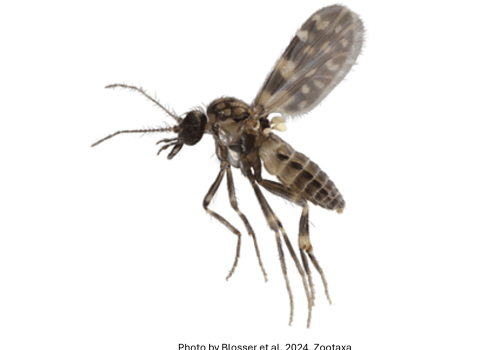
A female biting midge (Culicoides sp.)

Native Vegetation Barriers Show Promise for Controlling Coastal Biting Midges

A new Australian study has demonstrated that purpose-grown vegetation barriers can substantially reduce nuisance biting midge populations in coastal residential…

  • May 2026
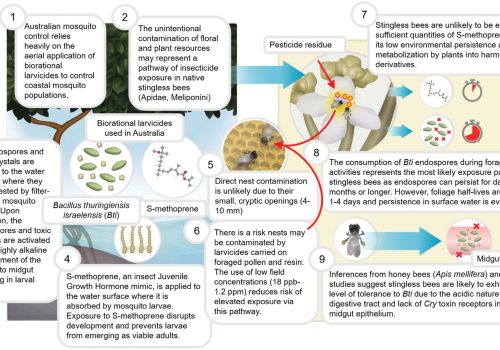
A summary of potential exposure pathways to mosquito control larvicides in coastal treatment sites.

Ensuring Mosquito Control Remains Safe for Australia’s Native Pollinators

A new review published in Environmental Entomology highlights the need for greater research into how mosquito control activities may affect…

  • May 2026
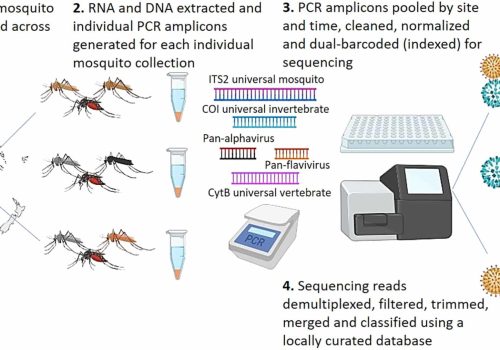
Workflow of the described all-in-one multi-loci metabarcoding approach to mosquito and arbovirus xenosurveillance.

MARC research delivers a new tool for improved mosquito and arbovirus surveillance

The MARC Scientist, members of QIMR Berghofer Mosquito Control Laboratory, and collaborating Australian health and vector surveillance agencies have developed…

  • January 2026
1 2 Next »
Loading...
A female biting midge (Culicoides sp.)

Native Vegetation Barriers Show Promise for Controlling Coastal Biting Midges

A new Australian study has demonstrated that purpose-grown vegetation barriers can substantially reduce nuisance biting midge populations in coastal residential…

  • May 2026
A summary of potential exposure pathways to mosquito control larvicides in coastal treatment sites.

Ensuring Mosquito Control Remains Safe for Australia’s Native Pollinators

A new review published in Environmental Entomology highlights the need for greater research into how mosquito control activities may affect…

  • May 2026
  • Home
  • About
  • Research
  • News
  • Join MARC
  • Log In
  • Privacy
  • ©2026 Mosquito and Arbovirus Research Committee (Inc.)

Contact Us

  • 07 3878 6152
  • info@marc.net.au
  • Website by iOnline
  • ©2026 Mosquito and Arbovirus Research Committee (Inc.)
  • Website by iOnline