Skip to content
Member Login
Log Out
Join MARC
Access Portal
  • Home
  • What We Do
  • Mosquito-Borne Diseases
  • News
  • Membership
  • Contact
  • Home
  • What We Do
  • Mosquito-Borne Diseases
  • News
  • Membership
  • Contact
Member Login
Join MARC

Home / Research / Ensuring Mosquito Control Remains Safe for Australia’s Native Pollinators

Ensuring Mosquito Control Remains Safe for Australia’s Native Pollinators

Share this article

Facebook
Twitter
LinkedIn

A new review published in Environmental Entomology highlights the need for greater research into how mosquito control activities may affect Australia’s native stingless bees.

The study, led by the MARC Scientist and collaborators at the University of Queensland, examined potential exposure pathways to mosquito control products and their risks to stingless bees (Meliponini) , which are culturally, ecologically and economically important native pollinators.

The review assessed existing evidence from mosquito control programs using larvicides such as Bacillus thuringiensis israelensis (Bti), alongside lessons learned from international honey bee studies. Researchers found that while Bti and other biorational larvicides are some of the most targeted and environmentally safe mosquito control agents available, significant knowledge gaps remain regarding the ecology, foraging behaviour, and insecticide susceptibility of Australian stingless bees.

The authors say improved understanding of stingless bee ecology will help ensure mosquito management programs continue protecting public health while minimising risks to non-target insects and maintaining ecosystem health.

The paper, titled “A review of the potential impacts of coastal mosquito control programs on Australian Stingless Bees (Apidae, Meliponini)—likely exposure pathways and lessons learned from studies on honey bees”, was published in the December 2024 issue of Environmental Entomology.
You may also like...

Loading...
A female biting midge (Culicoides sp.)

Native Vegetation Barriers Show Promise for Controlling Coastal Biting Midges

A new Australian study has demonstrated that purpose-grown vegetation barriers can substantially reduce nuisance biting midge populations in coastal residential…

  • May 2026
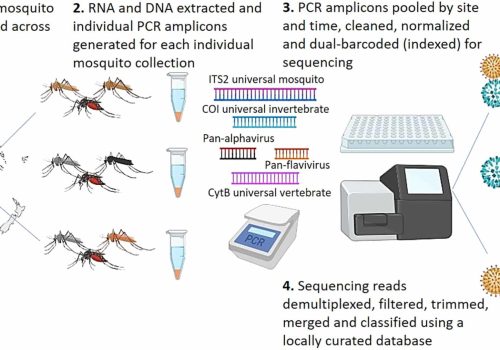
Workflow of the described all-in-one multi-loci metabarcoding approach to mosquito and arbovirus xenosurveillance.

MARC research delivers a new tool for improved mosquito and arbovirus surveillance

The MARC Scientist, members of QIMR Berghofer Mosquito Control Laboratory, and collaborating Australian health and vector surveillance agencies have developed…

  • January 2026
Australia's most common backyard mosquito and a frequent subject of MARC research.

The MARC celebrates more than 30 years of pioneering research

The year 2026 marks 34 years since the establishment in 1992 of the Local Authorities Research Committee (LARC) in South…

  • October 2025
Loading...
A female biting midge (Culicoides sp.)

Native Vegetation Barriers Show Promise for Controlling Coastal Biting Midges

A new Australian study has demonstrated that purpose-grown vegetation barriers can substantially reduce nuisance biting midge populations in coastal residential…

  • May 2026
Workflow of the described all-in-one multi-loci metabarcoding approach to mosquito and arbovirus xenosurveillance.

MARC research delivers a new tool for improved mosquito and arbovirus surveillance

The MARC Scientist, members of QIMR Berghofer Mosquito Control Laboratory, and collaborating Australian health and vector surveillance agencies have developed…

  • January 2026
  • Home
  • About
  • Research
  • News
  • Join MARC
  • Log In
  • Privacy
  • ©2026 Mosquito and Arbovirus Research Committee (Inc.)

Contact Us

  • 07 3878 6152
  • info@marc.net.au
  • Website by iOnline
  • ©2026 Mosquito and Arbovirus Research Committee (Inc.)
  • Website by iOnline